
Industry update
Trump Wants Tiny Cars in America. What Does That Mean for Japanese Kei Cars?
President Trump says American automakers should build tiny cars. Here is what was actually said, what has not changed, and what it could mean for Japanese Kei cars.
- Author
- Nexus JDM Imports
- Review status
- Reviewed and updated July 2026
- Originally published
- July 29, 2026
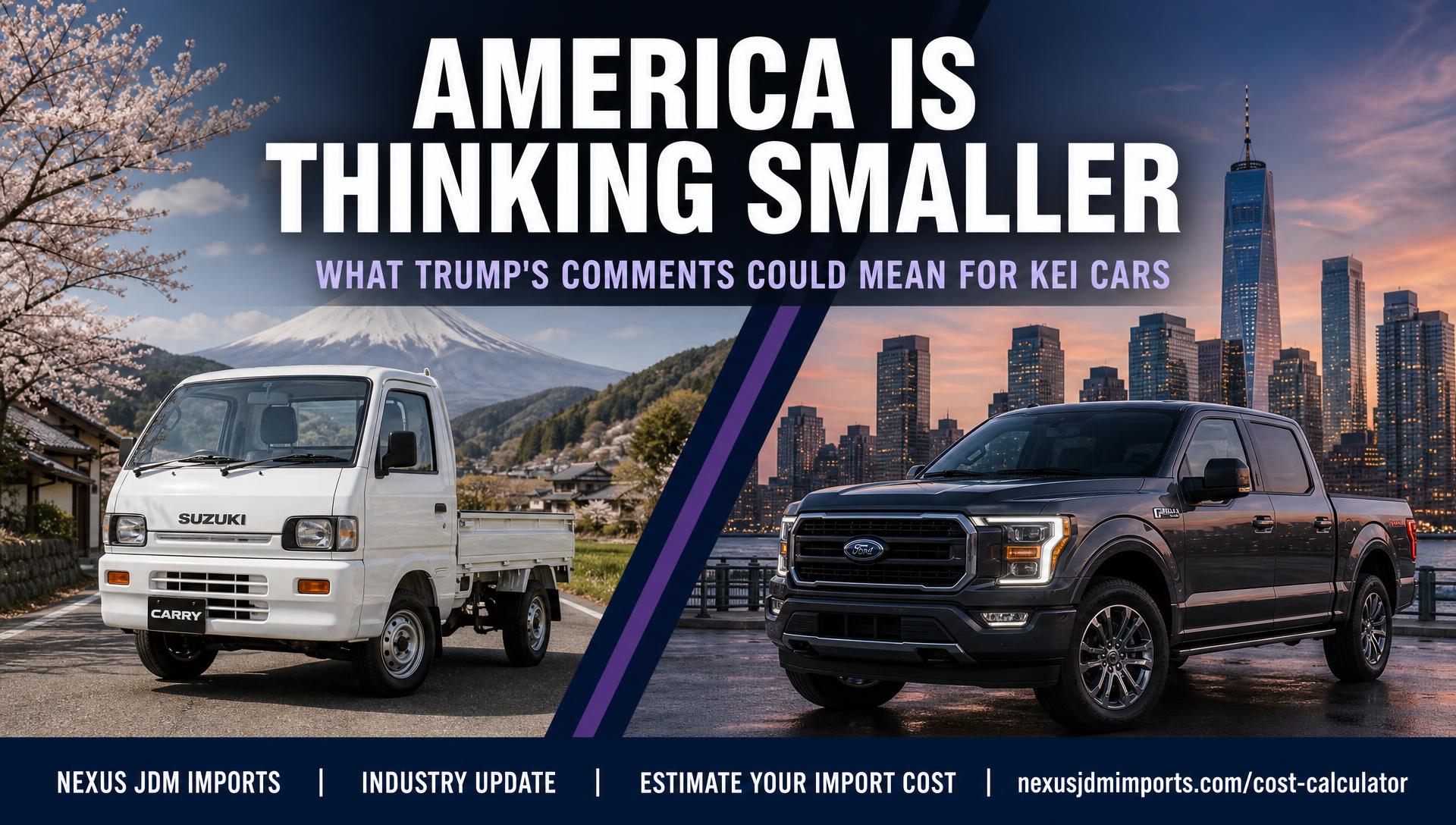
America is thinking smaller. Trump's comments have renewed discussion about compact vehicles, but they do not automatically change the rules for importing modern Japanese Kei cars.
A short set of remarks about small cars has produced a very large amount of speculation. Enthusiasts immediately asked the obvious question: if the White House wants tiny cars on American roads, does that mean a brand new Suzuki Every or Daihatsu Hijet can finally be imported and registered here? The honest answer, based on what has actually been published, is no. Encouraging domestic production of small vehicles is a different thing from rewriting federal import law.
1. What Trump actually said at GM's Milford Proving Ground
During an appearance at General Motors' Milford Proving Ground in Michigan, the President spoke about American manufacturing and pushed automakers toward building smaller, cheaper vehicles rather than continuing to scale up trucks and SUVs. Coverage of the visit described him calling for tiny cars and framing them as an affordability and manufacturing opportunity for domestic builders. [Source: MotorBiscuit: Trump demands tiny little tiny cars at GM proving grounds]
Read the remarks for what they are. They were public comments about what American companies should build. They were not the announcement of a regulation, a rulemaking notice, an exemption, or a change to any import pathway. General Motors publishes its official product and policy announcements through its own newsroom, and a manufacturing or product commitment would appear there rather than being inferred from event coverage. [Source: General Motors: company news]
2. What a Kei car actually is
Kei cars, short for kei jidosha or light vehicles, are a Japanese regulatory class rather than a body style. To qualify in Japan, a vehicle must stay inside strict limits on length, width, height, and engine displacement, with displacement capped at 660cc under the current standard. In exchange, owners in Japan receive tax, insurance, and in some areas parking benefits.
The category covers far more than one shape. Familiar examples include the Suzuki Carry and Every, the Daihatsu Hijet and Copen, the Honda Acty, Beat, and N-Box, the Subaru Sambar, and the Autozam AZ-1. Kei trucks and Kei vans dominate the working end of the class, while the sports models became collector favorites.
Because Kei rules are Japanese domestic rules, a Kei vehicle is designed and certified for the Japanese market. It is not built to United States Federal Motor Vehicle Safety Standards, and that fact drives everything that follows.
3. Did Trump legalize modern Japanese Kei cars?
No blanket legalization has been confirmed. There is no published federal action removing the age-based framework that governs the importation of vehicles that were never certified to United States standards, and NHTSA's own importation guidance continues to describe that framework as the controlling path. [Source: NHTSA: importation and certification FAQs]
Statements of preference from any administration do not change a federal safety or emissions requirement on their own. A real change would need a formal process, published notice, and agency implementation. Until that exists in writing from the responsible agency, treat the current rules as the rules.
4. A new U.S.-certified tiny car is not a Kei import
If an American manufacturer decides to build a small, inexpensive car for the domestic market, that vehicle would be certified from the start to United States safety and emissions standards. It would arrive at a dealer with a compliance label, a manufacturer warranty, and a normal titling path in every state.
A Japanese-market Kei vehicle has none of that. It was certified for Japan, it carries Japanese documentation, and it enters the United States through the import process rather than the retail certification process. Even if small cars become fashionable in American showrooms, that popularity does not convert a foreign-certified vehicle into a certified one.
| Question | New U.S.-certified small car | Japanese-market Kei import |
|---|---|---|
| Certified to FMVSS | Yes, from the factory | No, certified for Japan |
| Path into the country | Normal domestic sale | Federal import process |
| Age considerations | None | Age-based provisions apply |
| State titling | Routine | Varies by state and vehicle class |
5. NHTSA's 25-year rule and why the manufacture month matters
For vehicles that were never certified to Federal Motor Vehicle Safety Standards, the most commonly used pathway is the exemption for motor vehicles that are at least 25 years old. NHTSA's importation and certification guidance explains this age-based treatment and the declaration made at entry. [Source: NHTSA: importation and certification FAQs]
The detail that catches buyers is that the clock runs from the actual date of manufacture, not the model year printed in a listing. A Kei van built in November is not eligible at the same moment as an identical van built in March of the same model year. Confirm the build month and year from the vehicle's own documentation before any money moves, because a vehicle that is a few months early is simply not eligible yet.
6. EPA runs a separate emissions pathway
Federal emissions requirements are administered by EPA and are evaluated independently of the safety question. EPA's import guidance describes the pathways available for vehicles entering the country, including age-based treatment for older vehicles, and the declaration form used at entry. [Source: EPA: learn about importing vehicles and engines]
One point deserves emphasis for Kei buyers. Age-based emissions treatment generally depends on the vehicle remaining in its original engine and emissions configuration. Kei vehicles are heavily modified in Japan, and swapped engines, removed emissions hardware, or turbo conversions can change the analysis entirely. The declaration forms EPA publishes are where those categories are actually claimed, so review them before you assume a given car qualifies. [Source: EPA: publications and forms for importing vehicles and engines]
- Ask the seller directly whether the engine is original to the chassis.
- Ask whether emissions components were removed, replaced, or bypassed.
- Get photographs of the engine bay and any aftermarket hardware before purchase.
- Treat undocumented modifications as a risk to price into the deal.
7. Federal clearance does not guarantee state registration
This is the part that surprises the most owners. Clearing federal import requirements means the vehicle may lawfully enter the country. It does not mean any particular state will title it, register it, or allow it on public roads.
State treatment of Kei vehicles has been genuinely inconsistent. Some states title and register them without unusual friction. Some restrict them to farm, off-road, or low-speed use. Some have reversed their own position more than once. A federal conversation about tiny cars does not change what your state motor-vehicle authority will do with a right-hand-drive 660cc van, so confirm your state's current position in writing before you buy.
8. Why the comments still matter
None of this means the story is irrelevant. Public attention shapes policy over time, and a sitting president talking about small vehicles moves the conversation from enthusiast forums into mainstream coverage.
Broader interest in compact vehicles can influence what manufacturers plan, how states think about small-vehicle classes, and which questions regulators are asked to answer. Those are real and worth watching. They are simply not the same as a published rule change, and the gap between attention and regulation is usually measured in years.
9. Buying a newer Kei car and waiting is speculative
A pattern shows up every time a headline like this circulates. Someone considers buying a two-year-old Kei truck now, storing it, and waiting for the rules to open up.
Understand what that plan actually is. You would be paying for a vehicle, paying to move or store it, and accepting currency, condition, and market risk while betting on a regulatory change that no agency has announced. If the change never arrives, the practical outcome is that you wait until the vehicle satisfies the existing age-based requirements anyway. Speculation is a legitimate personal choice, but it should be made with open eyes rather than on the strength of a quote.
10. Buyer verification checklist
- Confirm the exact manufacture month and year from the vehicle's own documentation, not the listing.
- Confirm the chassis number matches every document and photograph you receive.
- Confirm whether the engine and emissions configuration are original to the vehicle.
- Request an auction sheet or condition report and a translation when the vehicle comes from an auction source.
- Request additional photographs of rust points, the undercarriage, and the engine bay.
- Confirm your state's current titling and registration position for Kei-class right-hand-drive vehicles in writing.
- Confirm who the Importer of Record will be and who will retain a licensed customs broker.
- Budget the full landed cost, including ocean freight, customs, port and release charges, and inland delivery.
- Verify any claim of a rule change against a primary government source before acting on it.
11. Bottom line
Trump's comments support or encourage domestic tiny-car production. They do not broadly legalize modern Japanese Kei vehicles for unrestricted importation and registration in the United States.
The practical path for a Kei vehicle today is the same one it was last month. Confirm the manufacture date against the federal age requirement, treat emissions as a separate question tied to original configuration, and confirm your state will actually register the vehicle. If that changes, it will change through a published action from the responsible agency, and that is the only source worth planning around.
Official references
Ready for the next step?
Build a planning estimate, compare what each service covers, or send us your request and we will tell you what happens next.
Questions? Email admin@nexusjdmimports.com.